Commercial E Waste Recycling IT Refresh Planning Guide
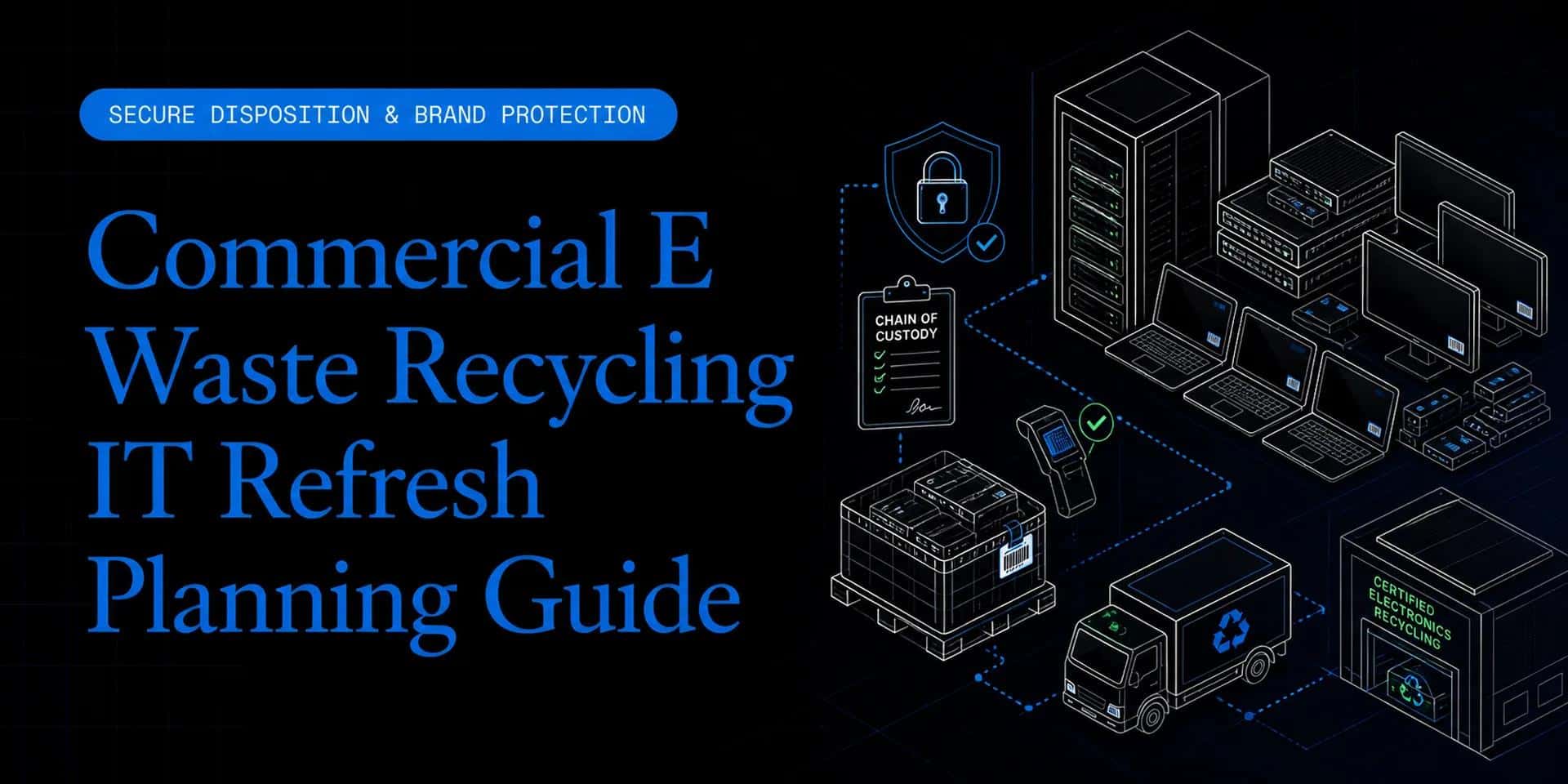
A large technology refresh is an operational transition, not simply a facilities project. Retiring servers, laptops, networking equipment, and office devices requires secure data handling, coordinated collection, documented custody, and a measurable path for recovered materials.
For enterprise teams, commercial e waste recycling it refresh programs combine IT asset disposition compliance. NIST 800-88-aligned data destruction, chain-of-custody tracking, and verified material recovery through one accountable partner.
That integrated approach helps IT, sustainability, procurement, and compliance leaders manage distributed refreshes without losing visibility between pickup and final processing. CheckSammy supports commercial e-waste recycling services with enterprise-scale execution and auditable sustainability outcomes. The first step is understanding how ITAD turns a hardware retirement into a controlled, verifiable process.
What Is ITAD and Why Does It Matter for Enterprise IT Refresh?
IT asset disposition (ITAD) is the controlled process for retiring, securing, and routing business technology at the end of its useful life. In an enterprise IT refresh, that can include laptops, servers, storage devices, networking equipment, and other assets removed from offices or data centers. ITAD turns a one-time technology change into a documented operational process that protects sensitive information, supports compliance, and recovers value from material streams.
How does NIST 800-88 guide data destruction?
NIST 800-88 provides a recognized framework for making data on storage media infeasible to access. The appropriate method depends on the device, the sensitivity of the information, and the intended end state.
- Clear: Applies logical techniques to make data inaccessible through standard interfaces while preserving the media for continued use in appropriate cases.
- Purge: Uses stronger logical or physical techniques to make recovery significantly more difficult, often while allowing the asset to remain usable.
- Destroy: Physically renders the media unusable when the risk profile or device condition requires it.
For a multi-site refresh, the method should be selected by asset type and risk, then tied to an auditable record. CheckSammy's commercial e-waste recycling services follow NIST 800-88 methods and report 100% data destruction compliance, giving IT, security, and compliance teams a clear standard for oversight.
Which certifications should enterprise buyers evaluate?
Certifications help buyers test whether a provider's controls are independently structured and consistently applied. Relevant credentials include R2 certification for responsible electronics recycling, e-Stewards requirements for downstream accountability, and NAID AAA certification for secure information destruction. CheckSammy also references SOC 2 Type II controls and EPA-aligned carbon calculations as part of its technology and sustainability framework.
Material recovery is another important measure. CheckSammy reports a 95%+ material recovery rate, which helps connect secure retirement with measurable recovery outcomes rather than treating security and sustainability as separate programs.
What does a mature ITAD program look like?
Enterprise buyers can benchmark process maturity against providers with long operating histories. For example, ITAMG states that it has operated for more than 26 years with zero reported data breaches, alongside R2v3 and NAID AAA certifications. That benchmark, documented by ITAMG, illustrates why buyers should ask for evidence of controls, not rely on general assurances.
For a deeper definition and planning framework, review CheckSammy's guide to IT asset disposition.
How Does Chain-of-Custody Documentation Work at Scale?
Large-scale IT refreshes require more than a pickup receipt. Each asset needs a traceable record that shows where it was collected, how it moved through processing, and when its data was destroyed. For enterprise teams managing thousands of laptops, servers, monitors, and networking devices, serial-number-level tracking creates the audit trail needed for security, compliance, and ESG reporting.
What happens during collection and transport?
The process begins with an inventory that connects each device to its serial number and project record. A white-glove pickup team secures the equipment using tamper-evident seals, then tracks the movement with GPS-enabled logistics. These controls help establish accountability between the facility, transportation route, processing location, and authorized destruction point.
That visibility matters when refresh work spans multiple offices or data centers. Instead of relying on a single batch-level handoff, IT and sustainability leaders can review asset movement through CheckSammy's sustainability technology platform and maintain a consistent record across locations.
Which records support an audit-ready refresh?
After processing, the documentation package connects the physical assets to their final outcomes. Depending on the project scope, it supports the following records. The documentation package includes:
- A Certificate of Destruction for each device or for an approved batch.
- A Chain of Custody Report showing key handoffs and processing milestones.
- A complete device catalogue with asset identifiers and condition notes.
- An Environmental Impact Report documenting relevant recovery and diversion outcomes.
- Regulatory alignment documentation for internal reviews and compliance records.
Certificates of Destruction are delivered within 24 hours of processing, giving project owners timely evidence that approved data-destruction requirements were completed. The record can then support security reviews, asset reconciliation, and sustainability reporting without requiring teams to reconstruct the project from separate vendor files.
How is downstream handling verified?
Chain of custody does not end when a device leaves the original facility. Downstream verification confirms that materials move through approved processing channels and are not exported to developing countries. That final control is essential for organizations that need confidence in responsible handling, brand protection, and the integrity of their commercial e-waste recycling IT refresh program.
What Makes Commercial E-Waste Recycling Different from Consumer Programs?
Consumer recycling programs are designed for occasional drop-offs and relatively small quantities. An enterprise IT refresh is an operational project involving coordinated pickups, thousands of serialized assets, secure data handling, and documentation that can withstand internal and regulatory review.
Comparison of consumer e-waste programs and commercial IT refresh programs.
Factor
Consumer recycling
Commercial IT refresh program
Volume per project
Single devices or small loads.
Thousands of serialized assets per project.
Data security
Basic wiping or none.
NIST 800-88 Clear, Purge, or Destroy methods.
Documentation
Receipt only.
Certificate of Destruction, Chain of Custody Report, device catalogue, and Environmental Impact Report.
Chain of custody
Batch-level tracking.
Serial-number tracking from pickup to final disposition.
Geographic scope
Local or regional drop-off.
Nationwide coverage with coordinated multi-site logistics.
Certifications
Often none.
R2, e-Stewards, NAID AAA, and ISO 14001.
Material recovery
Basic separation.
95 percent or higher recovery rate with downstream verification.
Commercial e-waste recycling for IT refresh must connect those requirements into one controlled workflow rather than treating each device as an isolated item.
The scale of the challenge is global. The world generated 62 billion kilograms of electronic waste in 2022, yet only 22.3% was documented as formally collected and recycled, according to the UN Global E-waste Monitor 2024. For a multi-location business, the right response is not simply finding a place to drop off equipment. It is coordinating asset collection, secure disposition, material recovery, and verified reporting across every site.
Volume, geography, and execution
Commercial programs are built for repeatable execution at enterprise volume. CheckSammy has diverted more than 175 million pounds from landfills and reports a 94% average diversion rate. Its nationwide coverage across North America is supported by more than 10,000 vetted professionals and a network of 25,000 facilities. That infrastructure helps businesses coordinate office upgrades, data center projects, and regional rollouts through one operating model.
The difference is also visible in project capacity. A commercial partner should be able to manage a retirement of 10,000 or more devices. Including laptops, servers, monitors, and other technology, with on-site or off-site destruction options and consistent tracking. CheckSammy reports a 99.2% first-visit completion rate, supporting schedules where missed pickups can delay an entire refresh.
Business outcomes beyond recycling
Enterprise procurement teams also evaluate cost and accountability. CheckSammy reports potential cost reductions of 30% to 40% compared with traditional waste haulers, while its technology-enabled model provides visibility into service execution and recovered material streams. Through ZeroPoint facility services, complex technology streams can be routed through infrastructure designed for sorting, aggregation, and recovery at scale.
That combination of capacity, geographic reach, security controls, and measurable outcomes is what separates a commercial IT refresh program from a consumer recycling option.
How to Plan an IT Refresh with Commercial E-Waste Recycling
A well-managed refresh treats retired technology as a controlled material stream, not an afterthought. Plan each handoff before equipment leaves the facility so IT, security, procurement, and sustainability teams can reconcile the same record from pickup through recovery.
- Secure collectionDefine pickup locations, access requirements, equipment volume, and the schedule for each site. Use a white-glove collection process with tamper-evident seals and GPS tracking. This establishes a defensible chain of custody before devices enter transportation and helps multi-location teams identify exceptions quickly.
- Asset inventoryRequire every device to be catalogued at intake. The record should include the serial number, make, model, condition, location, and any relevant asset-management identifier. Serial-number-level records connect the physical equipment to the organization's IT asset register and provide the baseline for later certificates and reporting.
- Data destructionChoose the treatment method according to the device, data sensitivity, and policy requirements. NIST 800-88 compliant wiping can use Clear or Purge methods when the media remains suitable for reuse. Physical destruction is available when the risk profile or equipment condition requires it. Define whether destruction occurs on-site or off-site, and require evidence for each completed asset.
- Material recoveryAfter data security requirements are complete, separate components and materials for the highest practical recovery value. A documented process should preserve usable equipment where appropriate while routing remaining material streams to qualified processors. CheckSammy reports a 95%+ material recovery rate for its electronic waste recycling services. Explore commercial recycling services for broader refresh planning.
- Downstream verificationDo not stop tracking when a processor receives the equipment. Verify each downstream path through final disposition, including the destination and treatment applied. The verification process should ensure materials are handled responsibly and are not exported to developing countries. This evidence supports internal controls, customer commitments, and ESG reporting.
- DocumentationSet the reporting requirement before the project begins. The final package should reconcile the device catalogue with chain-of-custody records, data-destruction evidence, material outcomes, and downstream verification. Certificates of Destruction should be delivered within 24 hours of processing when available, giving security and sustainability stakeholders a timely audit trail.
For complex refreshes, integrate the workflow with asset-management systems and assign one accountable owner for exceptions. That structure keeps commercial e-waste recycling aligned with security controls, recovery goals, and operational deadlines.
What to Look for in a Commercial E-Waste Recycling Partner
The right partner should function as an extension of your IT, security, and sustainability teams, not as a downstream handoff after equipment leaves the facility. For an enterprise refresh, evaluate providers against these criteria before approving a program.
- Recognized certifications: Look for R2 and e-Stewards certifications for responsible electronics processing, NAID AAA for secure information destruction, and ISO 14001 for environmental management. These standards provide a more meaningful baseline than a general recycling claim.
- Documented data destruction: Your provider should follow NIST 800-88 and clearly identify whether each asset is cleared, purged, or destroyed. The process should produce verifiable evidence for every device, not only a summary statement for the project.
- Serial-number-level chain of custody: Asset tracking should connect the device identifier to collection, transport, processing, data destruction, and final disposition. Tamper-evident handling and shipment visibility add controls during the highest-risk points of the refresh.
- Audit-ready documentation: Ask when Certificates of Destruction, chain-of-custody reports, device catalogues, condition notes, and environmental impact documentation become available. CheckSammy delivers Certificates of Destruction within 24 hours of processing, supporting faster audit and compliance workflows.
- Enterprise operating capacity: Nationwide coverage across North America, coordinated field service, and dedicated account management matter when a refresh spans offices, data centers, or multiple business units. A single accountable partner reduces fragmented reporting and execution risk.
- Technology integration: The provider should integrate with asset management systems so serial-level records can move into existing IT workflows. CheckSammy combines this integration with real-time operational visibility and verified downstream outcomes.
CheckSammy meets these requirements through its commercial e-waste recycling services, including R2-certified processing, e-Stewards and NAID AAA certifications, NIST 800-88-aligned data destruction, and documented chain of custody. That combination gives enterprise teams one partner for secure collection, accountable processing, and audit-ready reporting throughout an IT refresh.
Frequently Asked Questions
What does ITAD include during a technology refresh?
IT asset disposition (ITAD) covers the controlled lifecycle of retired equipment, including secure collection, asset inventory, data destruction, material recovery, downstream verification, and audit-ready documentation. A structured process helps IT and sustainability teams coordinate server decommissioning, office equipment upgrades, and data center migrations through one accountable workflow.
What does NIST 800-88 mean for retired business devices?
NIST 800-88 is the standard used to guide media sanitization decisions. Depending on the device and risk profile, approved methods can include Clear, Purge, or Destroy. CheckSammy states that its data destruction services follow NIST 800-88 methods. See the service details.
How long should chain-of-custody records be kept?
Keep records according to your organization's retention policy, contractual requirements, and applicable regulatory obligations. The documentation should connect each asset to its movement and final disposition. Serial-number tracking, custody reports, destruction certificates, and environmental records make the refresh easier to defend during internal or external audits.
Which data destruction method is right for an IT refresh?
The right method depends on the media type, security requirements, reuse plans, and risk assessment. Clear or Purge may suit assets approved for reuse, while Destroy is appropriate when the media cannot be safely reused or policy requires physical destruction. Define the method before collection so it is applied consistently and documented.
Why does R2 certification matter when choosing an e-waste partner?
R2 certification indicates that a processor follows a recognized framework for responsible electronics recycling, including environmental, worker-safety, and downstream-management controls. It should be evaluated alongside data-security certifications, chain-of-custody controls, material recovery reporting, and the partner's ability to support enterprise-scale deployments.
Ready to Plan Your Enterprise E-Waste Recycling Program?
A coordinated technology refresh can help your IT and sustainability teams manage equipment retirement with clearer documentation and a more consistent process across locations. To discuss your scope, material streams, and service requirements, request a quote for enterprise e-waste recycling from CheckSammy. Share your timeline and approximate equipment volume so the team can recommend an approach that fits your refresh.