Corporate Furniture Decommissioning and Landfill Diversion Guide
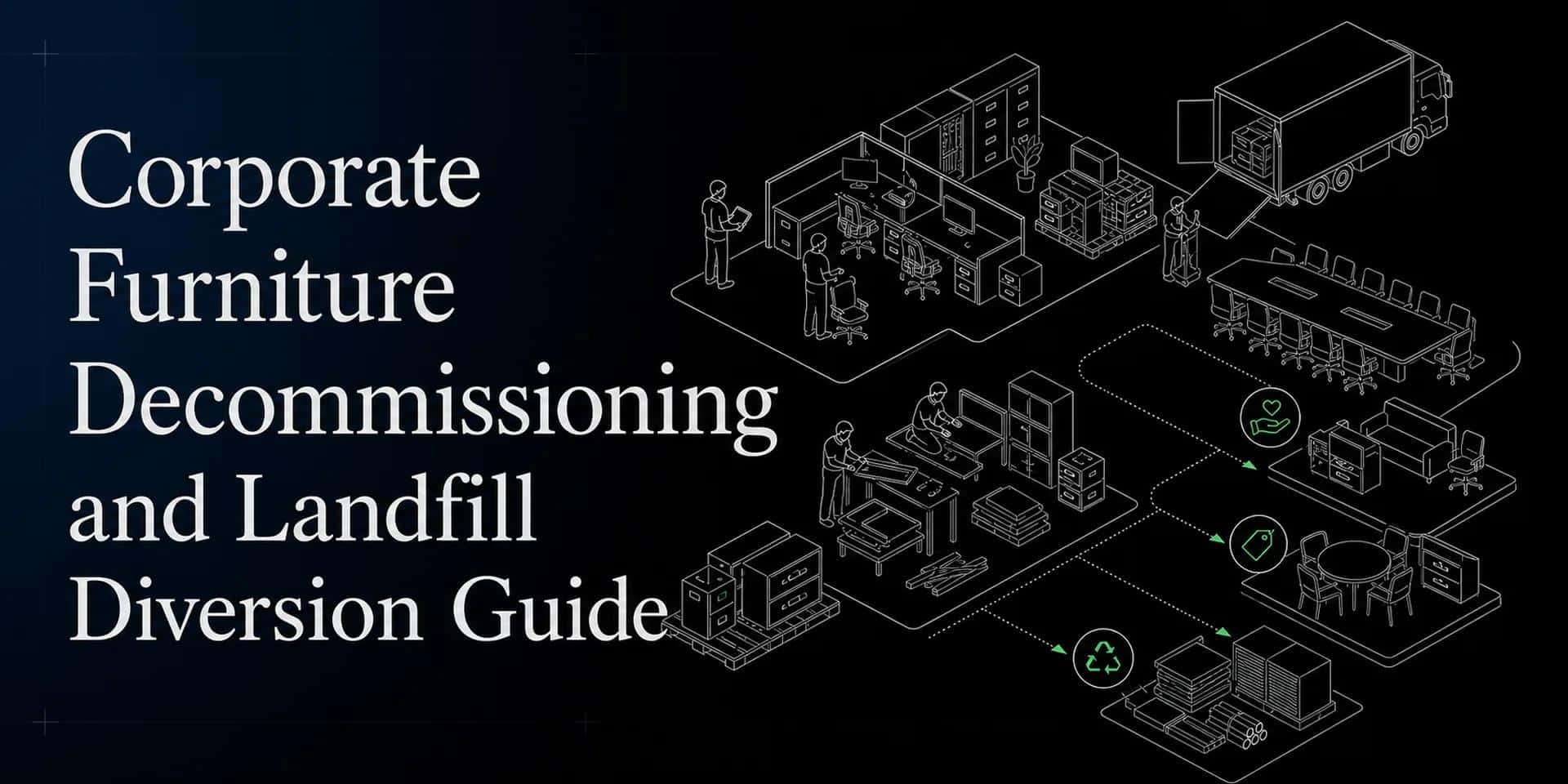
A workplace refresh, consolidation, or closure puts a compressed materials-handling problem in front of facilities and real estate teams: hundreds or thousands of workstations, task chairs, casegoods, and conference assets have to leave the floor on a fixed schedule without blowing past budget or diversion goals. Office furniture decommissioning is the discipline that turns that scramble into a measurable, repeatable program, and for enterprises running many sites it is the difference between a landfill invoice and a documented diversion result.
Plan an enterprise furniture decommissioning program with CheckSammy.
Most organizations treat furniture as an afterthought in a move or buildout, handled by whoever is available in the final week. That timing is where cost and reputational risk accumulate: rushed hauls default to disposal, resale windows close, and the sustainability team is left with no data to report. The programs that perform start planning disposition the moment the space decision is made.
Plan corporate furniture decommissioning before the move begins
A furniture decommissioning plan should inventory every asset, assign each one an approved recovery path, sequence pickups around the project schedule, and define the closeout records the business needs. Building the plan early gives facilities, procurement, and sustainability leaders time to resolve exceptions before they threaten the move-out date or the diversion target.
Decommissioning is a project, not a pickup. It has a scope, a timeline, dependencies, and stakeholders, and it benefits from the same rigor as any other capital or facilities workstream. The first job is to understand what you actually have.
Inventory the assets early
Start with a walkthrough of every floor, storage room, and off-site cage. Corporate environments hold far more than desks and chairs: modular systems furniture, height-adjustable bases, filing and casegoods, lobby and lounge seating, conference tables, monitor arms, and connected electronics such as displays, room controllers, and network gear. Capture quantities, condition, and manufacturer where it matters for resale. An early, honest inventory is the single input that determines how much you can divert; teams that skip it end up defaulting mixed loads to the landfill because there was no time left to sort.
Assign roles and a single program owner
Furniture decommissioning crosses facilities, procurement, IT, sustainability, and often corporate real estate. Name one program owner accountable for the outcome, then define clear roles underneath: facilities manages site logistics and access, procurement owns vendor selection and budget, IT handles any connected or data-bearing assets, and sustainability defines the diversion target and the reporting the business will report against. A named owner keeps the effort from fragmenting into a dozen local decisions that no one can measure later.
Set the diversion target up front
Decide what "success" means before the first truck arrives. A diversion target, expressed as the percentage of material by weight kept out of landfill, gives the whole team a shared goal and makes vendor selection concrete. That target should be written into the plan and the vendor scope so recovery is a requirement, not a hopeful outcome. It also gives the sustainability team a defensible number to fold into corporate reporting once the project closes.
Triage furniture for reuse, resale, and recycling
Triage sorts every asset into the highest-value recovery path first: internal redeployment, resale, donation, recycling, and only then disposal. Working down that hierarchy captures value, supports diversion goals, and shrinks the volume that ever reaches a landfill.
The core of a strong program is a disposition hierarchy applied consistently across every location. Each step keeps material in use longer and moves disposal to the last resort rather than the default.
Redeploy and resell what still has value
The most sustainable outcome for a piece of furniture is continued use. Before anything leaves the building, check whether assets can be redeployed to another site during a consolidation, or stored for an upcoming buildout. Quality systems furniture, recent-model task seating, and conference assets often carry meaningful resale value on the secondary market, which can offset removal costs. TheEPA's sustainable materials management frameworkputs reuse ahead of recycling for exactly this reason: it preserves the embodied energy and materials already invested in the product.
Donate to extend useful life
Serviceable furniture that has no internal home or resale market is often a strong donation candidate. Schools, nonprofits, and community organizations can absorb desks, chairs, and storage, and qualified donations generate the documentation the business needs to record the diversion and any associated tax benefit. Donation works best when it is planned into the schedule; last-minute offers rarely find a taker in time.
Recycle by material stream
Whatever cannot be reused enters the recycling path, and here segregation is everything. Office furniture is a mix of steel and aluminum, wood and particleboard, textiles, foam, plastics, and glass, and each stream has its own recovery route. Connected assets, displays, room systems, and other electronics, must be handled as e-waste rather than mixed into general bulk. Separating materials at the source, instead of sending a commingled load, is what pushes a program toward high, verifiable diversion rates. CheckSammy'sZeroPoint Diversion Hubsexist to consolidate and process these streams so recovery is measured on certified scales rather than estimated.
Handle data-bearing and sensitive assets correctly
Any furniture-adjacent asset that stores data or carries brand identity needs controlled handling: displays, room controllers, and network gear require documented data destruction, and branded fixtures need secure removal to prevent misuse. Treat these as a distinct, tracked stream inside the decommissioning plan.
Corporate decommissioning is rarely just furniture. Conference rooms, reception areas, and executive floors mix in electronics and brand assets that carry security and reputational risk if they leave the building unmanaged.
Destroy data on connected assets
Displays, video-conferencing systems, digital signage, and networking equipment can retain configuration data or credentials. These should be routed through a documented data-destruction process that returns a certificate for each asset or lot, so the security and compliance teams have proof that no data left with the hardware. Fold this step into the IT workstream early, because it often gates when an item can physically leave the site.
Secure branded and regulated items
Signage, custom fixtures, and anything carrying the company mark should be removed under control rather than tossed into an open container where it can be recovered and misused. Chain-of-custody handling from the floor to final disposition protects the brand and satisfies the internal stakeholders who care about where regulated or identifiable material ends up.
Sequence pickups to protect the project schedule
Sequencing aligns removals with the project timeline: stage assets by disposition path, book specialized pickups in advance, and schedule the final sweep so the space is empty and documented by the handoff date. Poor sequencing is the most common reason decommissioning slips and defaults to disposal.
A decommissioning plan lives or dies on logistics. On a fixed move-out or landlord-handoff date, the order and timing of removals determines whether you hit both the schedule and the diversion target.
Stage assets by disposition path
Group and stage material by where it is going, resale, donation, recycling by stream, and disposal, so each pickup is clean and efficient. Mixed staging forces sorting at the truck and invites the shortcut of landfilling everything to save time. Clear zones, labeling, and a simple site map keep crews moving and keep the diversion plan intact under deadline pressure.
Book specialized and bulk pickups ahead
E-waste, large systems furniture, and high-volume loads often need specific equipment, open-top or roll-off containers, or scheduled routing. Booking these in advance prevents the last-minute gap where an item sits with nowhere to go and gets thrown in the general dumpster. Same-day and nationwide dispatch capacity matters most here, because a single missed pickup can cascade into a schedule slip.
Confirm the final site sweep
Close every location with a documented walkthrough confirming the space is empty, clean, and ready for landlord or new-tenant handoff. The sweep is also the moment to reconcile the inventory against what actually left and by which path, which feeds directly into the diversion report.
Document chain of custody and measure diversion
Documentation is what turns a cleanout into a reportable diversion result. Chain-of-custody records, weight tickets, and certificates of recycling, donation, and data destruction prove final disposition and give sustainability teams audit-ready numbers for ESG and corporate reporting.
For an enterprise, the outcome that matters is not just an empty floor, it is a defensible record of where the material went. Without documentation, even a well-run decommissioning produces no data the business can report or verify.
Capture chain of custody and weights
Track each asset stream from the point it leaves the floor to its final destination, with weight tickets from certified scales establishing the tonnage diverted versus disposed. Real-time chain-of-custody records remove the guesswork and give the team a continuous, auditable trail rather than a reconstructed estimate after the fact.
Collect certificates of final disposition
Recycling certificates, donation receipts, and data-destruction certificates confirm that material reached the destination the plan intended. These documents are the backbone of both compliance and the diversion rate you will report, and they should be collected as the project runs, not chased down weeks later. Automated reporting that assembles these records into a single, standardized output saves the sustainability team significant manual effort.
Report the diversion outcome
Roll the weights and certificates into a single diversion figure, the share of total material by weight kept out of landfill, and tie it back to the target set at the start. A clean, documented number is what makes the program credible to leadership, auditors, and any external ESG framework the company reports into.
Scale decommissioning across a multi-location program
Multi-site programs succeed on standardization: one master playbook, a central operations owner, consistent vendors, and consolidated reporting across every location. That structure keeps schedules predictable, diversion measurable, and cost controlled as project count grows.
A single office decommissioning is a project. A portfolio of closures, consolidations, and refreshes is a program, and it needs program-level infrastructure to stay consistent as volume scales. Treating each site as a one-off is where cost and diversion performance drift apart across a large footprint.
Standardize on one master playbook
Build a single playbook that defines asset categories, the disposition hierarchy, pickup sequencing, and required closeout records, then apply it at every site. Standardization means each location produces comparable data and predictable results, so leadership can see performance across the portfolio instead of a patchwork of local approaches.
Centralize vendors and reporting
Consolidating removal, recycling, and reporting under a single national partner replaces a fragmented set of local haulers with one accountable relationship, consistent chain-of-custody handling, and one consolidated diversion report. That consolidation is also where cost savings appear, often in the range of 30 to 40 percent against traditional multi-vendor hauling, alongside a single source of truth for ESG data. A partner with nationwide same-day dispatch and certified diversion reporting lets a lean corporate team run many simultaneous projects without losing visibility.
Enterprise furniture decommissioning checklist
Use this checklist as the backbone of any office furniture decommissioning project and adapt it to each site's scope and schedule.
- Plan:Confirm the space decision, name a program owner, and set a written diversion target before any work begins.
- Inventory:Walk every floor and storage area; capture quantity, condition, and asset type, including connected electronics and branded fixtures.
- Triage:Assign each asset a disposition path in priority order, redeploy, resell, donate, recycle by material, then dispose.
- Secure:Route data-bearing and branded assets through documented data destruction and controlled removal.
- Sequence:Stage material by disposition path and book specialized, bulk, and e-waste pickups in advance of the move-out date.
- Document:Collect chain-of-custody records, weight tickets, and certificates of recycling, donation, and data destruction as the project runs.
- Report:Reconcile the inventory, roll up the diversion figure against the target, and deliver an audit-ready summary to sustainability and leadership.
- Close:Complete a documented final sweep and secure landlord or new-tenant sign-off for every location.
Frequently Asked Questions
What is office furniture decommissioning?
Office furniture decommissioning is the planned removal, triage, and disposition of workstations, seating, casegoods, and related assets when a workplace closes, consolidates, or refreshes. A strong program routes each item to reuse, resale, donation, or recycling before considering landfill, and documents where every stream ended up.
How do enterprises divert office furniture from landfill?
Diversion starts with an early asset inventory so items can be resold, redeployed, donated, or recycled by material. Segregating metal, wood, textiles, foam, and electronics at the source lets qualified partners recover value and produce the records that prove diversion rather than disposal.
How do you decommission furniture across multiple office locations?
Use one repeatable playbook, a central program owner, consistent vendors, and consolidated reporting. Standardizing asset categories, pickup sequencing, and closeout records across sites keeps schedules predictable and diversion measurable as project volume grows.
What documentation proves furniture was diverted, not landfilled?
Chain-of-custody records, weight tickets from certified scales, and certificates of recycling, donation, and data destruction together prove final disposition. Assembled into a single diversion report, they give sustainability and compliance teams an audit-ready result.
Plan your next furniture decommissioning with CheckSammy
Whether you are refreshing one headquarters or decommissioning furniture across a national footprint, the outcome depends on planning disposition early, triaging every asset to its highest-value path, and documenting where the material went. CheckSammy runs enterprise decommissioning as a single, measurable program, nationwide dispatch, certified diversion, and automated reporting, so your team hits the schedule and the sustainability target at once.
Talk to CheckSammy about an enterprise furniture decommissioning and diversion program.