Enterprise Multi-Location Recycling Program: Design and Implementation Guide
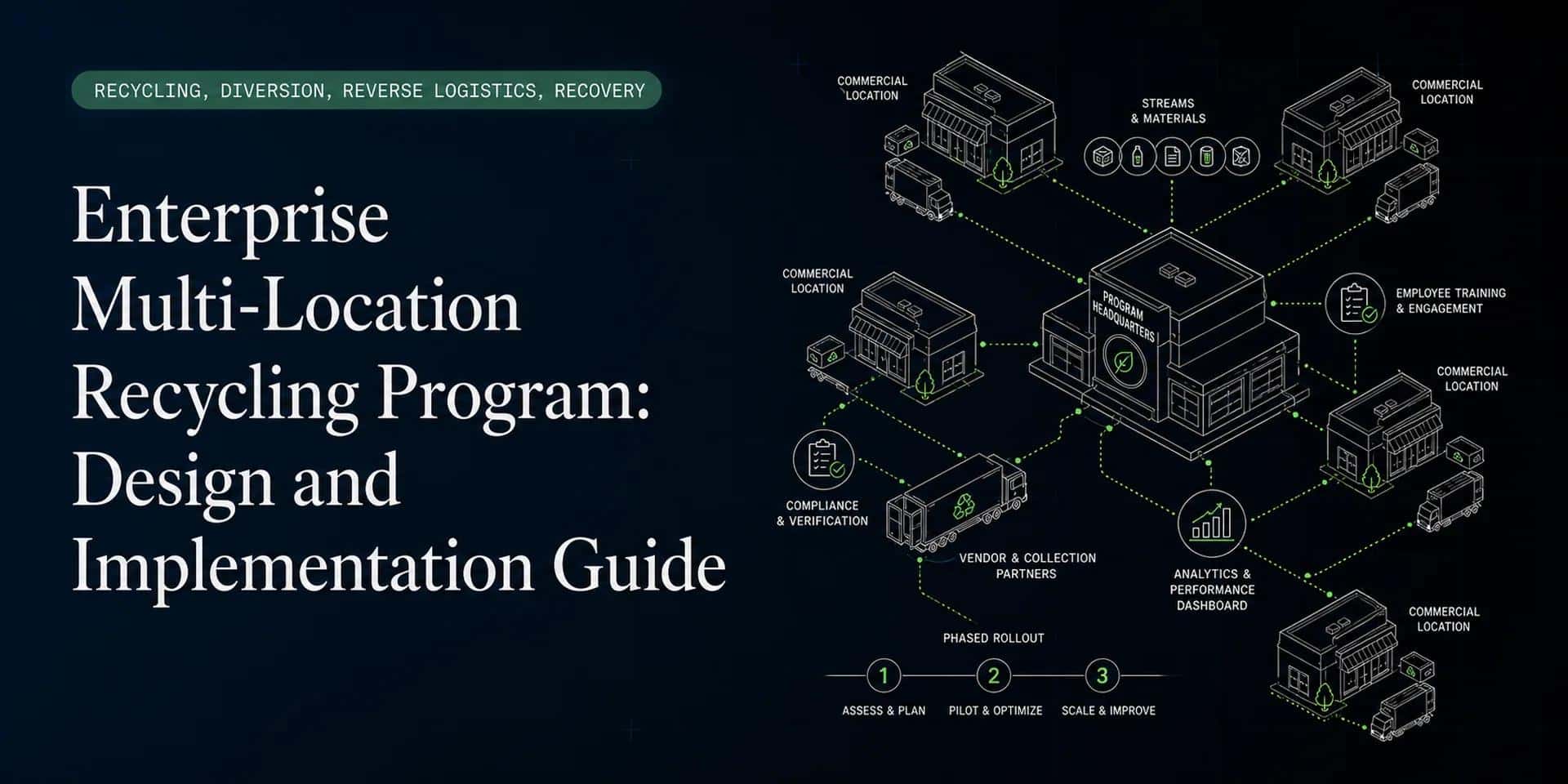
At enterprise scale, recycling performance can vary sharply from one facility to the next. Local vendors, inconsistent instructions, and disconnected reporting make it difficult for sustainability leaders to know whether a material stream was recovered, where contamination occurred, or how results compare across the portfolio.
A multi-location recycling program creates a repeatable operating model for every site, combining standardized procedures, coordinated service coverage, and auditable chain-of-custody data. With the right structure, leaders can manage complex material streams across dozens or hundreds of facilities while producing credible, decision-ready sustainability reporting. CheckSammy has diverted more than 175 million pounds across a network of 25,000+ facilities.
Get started building your multi-location recycling program. Contact CheckSammy today.
The challenge is not simply adding recycling services. It is creating the governance, accountability, and visibility needed to make performance consistent across locations. That foundation determines whether a program scales cleanly or fragments under operational pressure.
Why Multi-Location Recycling Programs Fail Without Centralized Structure
Multi-location recycling programs fail most often because each facility operates independently with different vendors, container types, service schedules, and material definitions. Without a central operating model, enterprise leaders lack the data and accountability needed to compare site performance, control costs, or produce audit-ready sustainability reporting.
A multi-location recycling program can look successful on paper while producing uneven results in the field. Each facility may have a different vendor, container setup, service schedule, training practice, and definition of what belongs in a recycling stream. Without a central operating model, local decisions accumulate into inconsistent performance that is difficult to measure or improve.
The problem is not simply that sites operate differently. It is that enterprise leaders lose the ability to see which differences are intentional, which are creating avoidable cost, and which are undermining diversion goals. The most common failure modes include:
- No shared operating standard: Sites use different collection procedures, signage, material definitions, and escalation rules. The EPA notes that effective multi-location programs require standardized operational procedures to support consistent diversion across facilities.
- Fragmented vendor management: Local contracts and one-off service arrangements create multiple points of contact, pricing structures, invoices, and performance expectations. This makes it harder for procurement and facilities teams to enforce accountability across the portfolio.
- Inconsistent data: One location may report by weight, another by pickup count, and another through estimates. Leaders then cannot reliably compare sites, validate outcomes, or build audit-ready ESG reporting.
- Reactive planning: Organizations wait until a contract is about to expire before reviewing service coverage, material streams, and performance requirements. The EPA recommends beginning the planning process two years before the end of a contract, giving teams time to assess needs, align stakeholders, and structure a competitive transition.
These issues are administrative as well as operational. The EPA describes effective recycling programs as a major administrative and political challenge, which means leadership alignment is as important as containers and collection routes. A centralized structure gives site teams clear requirements while preserving room to adapt to local conditions. It also creates a consistent framework for reviewing procedures as material volumes, facility needs, and market conditions change.
That structure should begin with a portfolio-wide view of material streams, vendors, service levels, and reporting gaps. A practical waste stream mapping exercise helps establish that baseline before the organization renegotiates contracts or expands diversion targets. Without it, even well-intentioned local improvements remain disconnected, and the enterprise cannot determine whether the program is delivering measurable progress.
How to Choose the Right Partner for a Multi-Location Recycling Program
The right partner replaces fragmented site-by-site vendor relationships with one accountable operating model. Evaluate providers on their ability to coordinate local execution across North America, produce auditable chain-of-custody data from every location, and deliver transparent pricing with measurable performance commitments. Vendor consolidation is the foundation of a scalable program.
The right partner should reduce operational complexity, not add another layer of coordination. Start by assessing whether the provider can replace fragmented site-by-site relationships with one accountable operating model. Vendor consolidation gives procurement and facilities teams a single commercial relationship, consistent service expectations, and one set of performance reports across the portfolio. It also makes gaps easier to identify because missed pickups, incomplete documentation, and inconsistent material handling are no longer hidden across separate vendors.
This matters because enterprise recycling programs involve more than selecting a collection provider. The EPA describes effective program development as a significant administrative and political challenge, which means leadership, governance, and clear accountability should be part of the buying decision. A provider that can support nationwide recycling services should be evaluated on its ability to coordinate local execution while maintaining a consistent enterprise standard.
Look beyond local availability
Local providers may know individual markets well, but a portfolio managed through multiple local relationships can create uneven service levels, different pricing structures, and incompatible reporting. A national provider should not simply subcontract work and disappear. Ask how it qualifies service professionals, monitors completion, handles exceptions, and maintains visibility from pickup through verified downstream processing. Nationwide coverage across North America allows an enterprise to apply the same operating requirements across jurisdictions while accounting for site-level realities.
The practical test is whether the provider can give your team one dashboard, one set of reports, and one escalation path without sacrificing local execution. Request examples of reporting by location, material stream, service date, diversion outcome, and exception status. If the answer requires manually combining spreadsheets from multiple vendors, the model is still fragmented. Many enterprises find that a structured recycling program benchmarking process helps establish the baseline metrics needed to compare provider proposals.
Require transparent pricing and measurable accountability
Transparent pricing should show what is included, how rates vary by material stream or service requirement, and which conditions trigger additional charges. Compare proposals on total program cost and operational reliability, not only on a single collection rate. Your enterprise recycling RFP should require standardized service definitions, reporting fields, escalation procedures, and measurable performance commitments.
Finally, confirm that the partner can produce decision-ready data rather than estimates. The strongest model combines centralized oversight with auditable documentation, giving sustainability, procurement, and facilities leaders a shared view of performance. That structure turns consolidation into more than administrative convenience: it creates the accountability needed to manage a multi-location portfolio at scale.
What a Structured Multi-Location Recycling Program Looks Like
A structured multi-location recycling program is a repeatable operating system built on material stream identification, container standardization, chain-of-custody tracking, contamination controls, and centralized data dashboards. Each location can adapt to local conditions, but the enterprise standard defines how materials are identified, handled, measured, and reported across the entire portfolio.
A structured program turns recycling from a collection of disconnected site activities into a repeatable operating system. Each location can have different volumes, layouts, and material profiles, but the enterprise standard should define how materials are identified, handled, measured, and reported. The EPA recycling toolkit emphasizes clear definitions and goals as a foundation for designing recycling and waste-reduction programs.
The core components typically include:
- Material stream identification: Start with a site-level assessment of the materials generated, such as cardboard, metals, plastics, organics, electronics, or specialized secondary materials. This determines which streams require dedicated handling and where aggregation or further sorting is needed. For electronic waste, e-waste recycling services provide specialized processing and compliance documentation.
- Container standardization: Use consistent container types, labels, placement rules, and collection frequencies wherever site conditions allow. Standardization reduces ambiguity for employees and service teams while preserving flexibility for locations with materially different volumes.
- Chain-of-custody tracking: Record each material movement from pickup through processing and final disposition. Real-time tracking and an auditable chain of custody help sustainability and operations teams verify that reported diversion reflects what actually happened. CheckSammy's ZeroPoint Facilities serve as sustainability logistics hubs that sort, aggregate, and route complex material streams.
- Contamination control: Define acceptable materials at the point of generation and reinforce those requirements through clear signage, training, inspections, and feedback. The EPA notes that recycling programs depend on consistent streams of high-quality, contaminant-free recovered materials that meet marketplace standards.
- Centralized data dashboards: Give stakeholders one view of service completion, weights, diversion, exceptions, and performance by site. A single dashboard makes it possible to identify underperforming locations, compare trends, and support enterprise reporting without manually reconciling disconnected records.
How do the components work together?
Operational reliability depends on connecting these elements. For example, standardized containers make material streams easier to identify, while tracking data shows whether pickups occurred as scheduled and where contamination or service exceptions are recurring. CheckSammy reports a 99.2% first-visit completion rate, a useful service metric for maintaining consistency across a large facility portfolio. Where streams are complex, CheckSammy's ZeroPoint Facilities sort, aggregate, and route materials through specialized sustainability logistics hubs.
When the operating model is implemented consistently, performance can be measured rather than estimated. CheckSammy reports a 94% average landfill diversion rate, verified through state-certified scales when applicable. That type of verification gives facility, procurement, and sustainability leaders a stronger basis for improving the program and communicating outcomes across the enterprise.
Factor
Localized Approach
Centralized Multi-Location Program
Vendor management
Multiple contracts, multiple contacts
One partner, one operating standard
Reporting
Site-level spreadsheets, inconsistent formats
Unified dashboard, auditable chain of custody
Cost visibility
Fragmented invoices, hidden fees
Transparent pricing, consolidated spend view
Diversion tracking
Estimated or unavailable
Verified via state-certified scales
ESG reporting
Manual data collection, slow
Automated, framework-aligned output
Financial and Reporting Benefits of Program Consolidation
Consolidating a multi-location recycling program under one accountable provider reduces costs by 30-40% compared with traditional haulers while replacing fragmented invoices with consolidated spend visibility, automated ESG reporting, and auditable chain-of-custody records that support GRI- and CDP-aligned disclosure.
Consolidating a multi-location recycling program under one accountable provider changes the financial conversation. Instead of managing disconnected invoices, inconsistent service levels, and incomplete site data, enterprise teams can evaluate one operating model against measurable cost and diversion outcomes. CheckSammy reports a 30-40% cost reduction compared with traditional haulers where the service model and logistics support that comparison.
That value does not come from cutting corners. It comes from coordinating service across locations, reducing administrative duplication, and using data to identify the material streams and sites that need attention. A structured waste audit for business process can expose avoidable volume, contamination patterns, and inconsistent site practices before they become recurring costs.
From fragmented spend to controllable economics
Centralization gives procurement and facilities leaders a clearer basis for budget planning. Service scope, site activity, diversion performance, and exceptions can be reviewed together rather than reconstructed from local records. This makes it easier to compare locations, prioritize corrective action, and treat recycling as an operational program with defined performance indicators.
- Cost control: Consolidated logistics and service management can reduce costs by 30-40% versus traditional haulers, where supported by the program context.
- Administrative efficiency: One operating model reduces repetitive vendor coordination, invoice review, and site-by-site data collection.
- Verified outcomes: CheckSammy reports more than 175 million pounds diverted across a network serving 25,000+ facilities, giving leaders a broader performance benchmark.
- Reporting productivity: Automated ESG waste reporting can save approximately 90% of manual reporting time for enterprise clients.
- Risk management: Controls aligned with SOC 2 Type II and NIST 800-88 requirements support stronger governance around data and secure disposition workflows.
Turning operational data into executive evidence
For a CSO or sustainability leader, the benefit extends beyond a cleaner monthly report. Auditable, framework-aligned data can support GRI- and CDP-aligned disclosures, including the evidence needed for Scope 3 supply-chain conversations. Real-time records and chain-of-custody documentation help connect each reported result to an operational event instead of relying on unsupported estimates.
The result is a shift from reactive cost center to strategic sustainability asset. Finance receives greater visibility into spend, operations receives a repeatable service model, and executives gain defensible evidence for performance reviews, procurement decisions, and stakeholder reporting.
Ready to consolidate your recycling program? Request a consultation with CheckSammy.
How to Launch and Scale Your Multi-Location Recycling Program
A successful multi-location recycling program launch follows five phases: audit existing material streams across every site, standardize material categories and container specifications, select one technology-enabled partner, implement real-time tracking and chain of custody, and connect performance data to ESG reporting with annual reviews.
A phased rollout gives enterprise teams a controlled way to replace fragmented processes with a consistent operating model. Rather than changing every site at once, establish the standards, technology, and measurement framework first, then expand in manageable waves.
- Phase 1: Audit existing material streams across every siteBegin with a baseline of what each facility generates, how volumes vary, which materials are currently recovered, and where contamination or service gaps occur. Document container locations, pickup frequency, local requirements, vendors, and reporting practices. A site-by-site audit reveals where a common standard will work immediately and where a location needs a tailored operating plan. It also prevents the confusion that comes from launching without a reliable view of current conditions. For multiple facilities, a multi-location waste diversion program framework can help structure the assessment phase.
- Phase 2: Standardize material categories and container specificationsDefine the material categories the program will accept, the quality requirements for each stream, and the container type, size, labeling, and placement required at each facility. Keep the core specification consistent, but allow documented exceptions for sites with different volumes, layouts, or local infrastructure. Clear definitions make training easier and help produce cleaner, more marketable recovered materials.
- Phase 3: Select one technology-enabled partnerChoose a partner that can coordinate service across the full portfolio while accommodating complex material streams. A single accountable partner reduces handoffs between local providers and creates one operating standard for procurement, facilities, and sustainability teams. For difficult or mixed streams, infrastructure such as ZeroPoint Facilities can sort, aggregate, and route materials through the appropriate recovery pathway.
- Phase 4: Implement tracking and chain of custodyRoll out real-time service visibility from pickup through processing and final disposition. A single dashboard should let stakeholders compare site performance, identify missed services, and review documentation without chasing separate vendors. Auditable chain-of-custody records connect operational activity to sustainability outcomes. CheckSammy reports a 94% average diversion rate, verified through state-certified scales when applicable, but each enterprise should establish its own baseline and track improvement over time.
- Phase 5: Connect performance to ESG reporting and review annuallyMap collected data to the metrics and reporting frameworks used by sustainability and compliance teams. Automated platforms can reduce ESG reporting time by approximately 90%, while centralized sustainability metrics make performance easier to validate and communicate. Review volumes, contamination, service reliability, diversion, and reporting quality at least annually. As material markets, facility footprints, and business priorities change, adjust procedures rather than allowing the original design to become obsolete.
Contact CheckSammy to discuss your enterprise recycling program. Get a free consultation.
Frequently Asked Questions
What is a multi-location recycling program?
It is a coordinated recycling framework that applies shared goals, material-stream definitions, service procedures, and reporting standards across multiple commercial facilities. Each site can adapt for local conditions while contributing consistent data to a company-wide diversion strategy. Standardized procedures are essential for consistent performance across facilities, according to the EPA guidance.
How much can an enterprise save by consolidating recycling vendors?
Savings depend on site count, material volumes, service frequency, and the existing vendor network. CheckSammy reports potential cost reductions of 30-40% compared with traditional waste haulers where the operating model and scope support that outcome. A waste audit and consolidated pricing review should establish the baseline before projecting savings.
How long does it take to implement a multi-site recycling program?
Implementation timelines vary based on the number of facilities, material streams, contract terms, and data requirements. A practical rollout typically starts with a portfolio assessment, then establishes standards, pilots the operating model, trains site teams, and scales in phases. The EPA recommends beginning the planning process well before an existing contract ends, allowing time for procurement and transition.
What data should a multi-location recycling program track?
Track material volumes by stream and site, diversion outcomes, contamination, pickup completion, service exceptions, chain of custody, and costs. For ESG reporting, retain auditable records that can support organizational goals and relevant reporting frameworks. Real-time tracking from pickup through disposition helps teams verify outcomes rather than relying on estimates.