Sustainable Product Returns Management for Retail and E-Commerce Chains
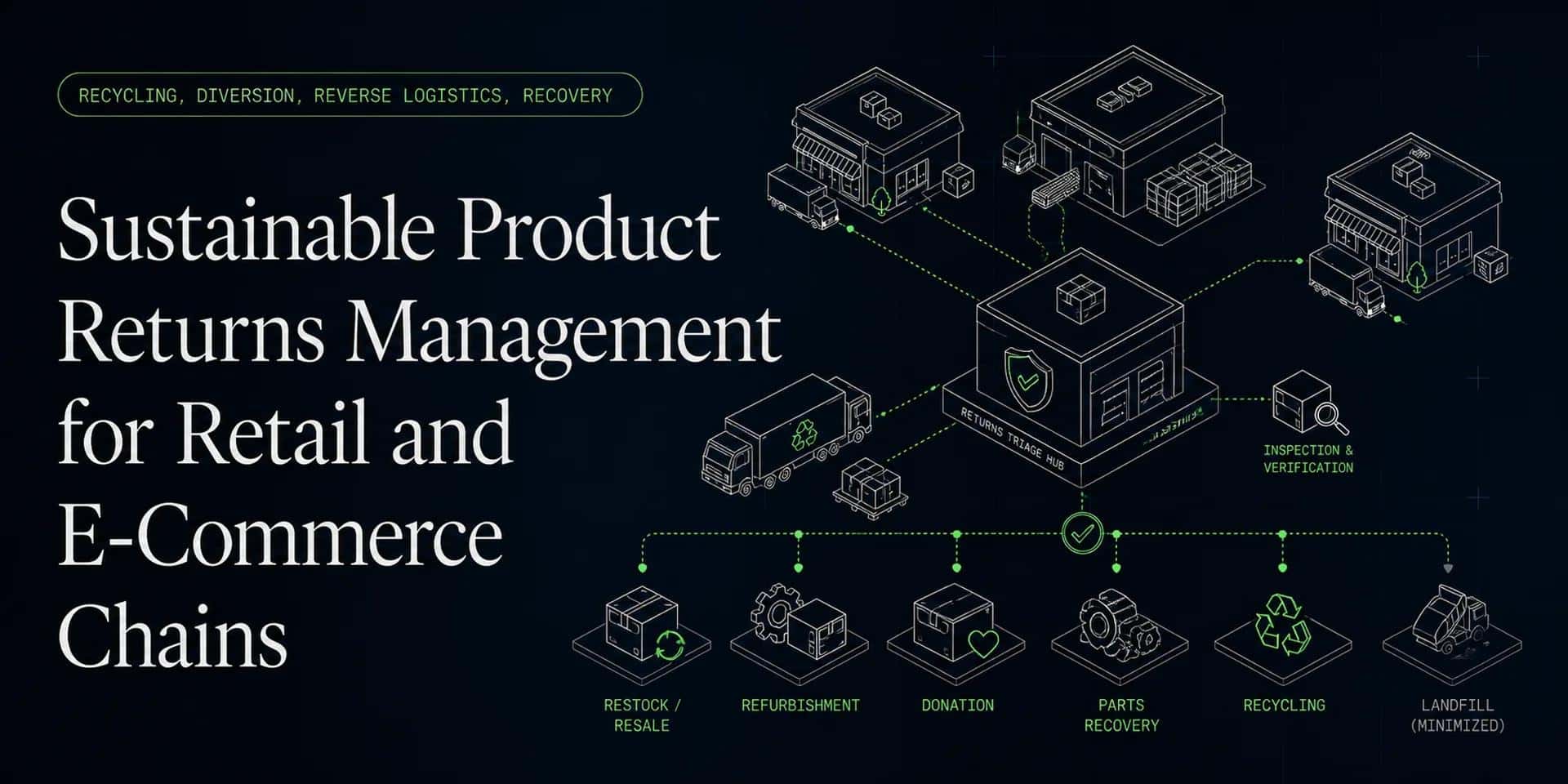
For a retail or e-commerce chain, a returned item is not simply a reverse shipment. It is a time-sensitive decision about resale, reuse, recycling, donation, or secure destruction, often across multiple locations and jurisdictions. When those decisions happen without consistent workflows or reliable data, value recovery and sustainability reporting become difficult to manage.
Sustainable product returns management coordinates inspection, disposition, reverse logistics. And reporting so each returned unit moves to its highest-value viable outcome while the organization maintains chain-of-custody visibility and measurable environmental results.
The operational challenge is especially significant for retailers handling diverse product categories and changing regulatory requirements across states, as the EPA notes. A practical program starts by defining what the process includes, which outcomes should be prioritized, and how performance will be measured from receipt through final disposition.
What Is Sustainable Product Returns Management?
Sustainable product returns management is the coordinated process of moving returned merchandise backward through the supply chain while protecting value. Reducing environmental impact, and documenting the outcome of every unit. It treats a return as an operational decision, not simply a shipment traveling in the opposite direction. For retailers and e-commerce organizations, that means connecting return intake, inspection, routing, recovery, and reporting across locations and partners.
How does the reverse logistics flow work?
The backward flow begins when a product leaves a customer or store and enters a returns network. It may pass through a consolidation point or reverse distribution center before an inspection determines its condition, ownership, compliance requirements, and next destination. Retailers commonly use reverse logistics centers to coordinate returned goods with suppliers and vendors, according to the U.S. Environmental Protection Agency.
A sustainable program then routes each item to its highest practical use. The primary paths are recommerce, recycling, donation, or certified destruction, with the decision based on product condition, market value, data security, material composition, and applicable regulations. This approach supports the broader reverse-logistics principle that effective return handling, reuse, and recycling can reduce material waste, as documented in recent academic research.
What components make the process sustainable?
- Structured intake and sorting: Returns are identified, grouped, and assessed consistently instead of being handled as an undifferentiated volume.
- Disposition decisions: Inspection and grading determine whether an item can be resold, donated, recycled, or requires a controlled final pathway.
- Unit-level data tracking: Lot and serial-number records connect each product to its movement and outcome, creating visibility for operations, procurement, and compliance teams.
- Verified reporting: Chain-of-custody records support audit-ready diversion and carbon reporting rather than relying on estimates.
How is this different from traditional returns?
Traditional returns programs often prioritize speed, refunds, and warehouse throughput. Sustainable product returns management adds a measured recovery strategy to those requirements. It asks what should happen next, who is accountable, and what evidence proves the result. For multi-location organizations, that distinction matters because product mixes, vendor arrangements, and regulatory expectations can vary by jurisdiction. A connected system makes those decisions repeatable and gives leaders the data needed to improve recovery over time.
The Cost of Unsustainable Returns , Environmental and Business Impact
Returns are not a single reverse-shipping expense. Every item moves through transportation, inspection, storage, repackaging, and a disposition decision. When those steps are disconnected, retailers absorb avoidable handling costs while usable products lose value and more material is sent to landfills.
Online purchases typically generate return rates three to four times higher than in-store purchases. That gap reflects the uncertainty of buying without physically evaluating a product, as well as the convenience of online return policies. Return volumes also doubled during the pandemic, accelerating pressure on warehouses, carriers, and processing teams. The environmental effect compounds across each additional shipment, including fuel consumption, packaging, and transportation-related carbon emissions.
Why return volume creates more than a logistics problem
The United States sends an estimated 5 billion pounds of returned goods to landfills each year, according to commonly cited EPA data. That figure represents lost opportunities for resale, refurbishment, donation, and material recovery. A product that could re-enter commerce or supply a usable component instead creates a cost at the end of its first sales cycle.
The commercial impact is equally significant. Unprocessed returns tie up working capital, consume warehouse space, increase labor requirements, and make inventory forecasting less reliable. They can also expose sensitive products and components to unnecessary handling. For retailers operating across multiple states, the compliance picture becomes more complex because product categories may trigger different hazardous-material and regulatory requirements. The EPA notes that retail organizations manage diverse products that can become regulated under RCRA, and that state-level interpretations can vary. Review the EPA's retail-sector guidance before standardizing a national workflow.
Regulation is making return accountability more important
Extended producer responsibility, or EPR, regulations are adding pressure for brands and retailers to document what happens after a product is returned. The practical response is not simply to move items faster. It is to create a repeatable decision process that records condition, destination, recovery outcome, and associated emissions. Research on reverse logistics identifies return handling, return costs, network design, reuse, and recycling as connected parts of the system. Academic research on reverse logistics supports treating these decisions as one operating model rather than isolated warehouse tasks.
A sustainable returns program protects margin and reduces environmental impact by directing each eligible unit toward its highest-value next use. While preserving the data needed to substantiate the result.
Refurbishment vs. Recycling vs. Resale , Choosing the Right Path for Each Return
Returned products should not all enter the same workflow. The right disposition depends on condition, demand, safety, data security, and the cost of restoring the item to a reliable saleable state. A change-of-mind return may retain substantial commercial value, while a damaged product may be better suited to material recovery. Electronics require an additional layer of control because data-bearing devices and regulated materials demand certified processing.
Consumer demand can support recovery-first decisions. A ReturnPro survey reports that approximately 70% of consumers have purchased refurbished products. Suggesting that refurbishment and resale can be credible value-recovery channels when quality and product history are managed carefully. For enterprise retailers, the objective is not to maximize resale at any cost. It is to route each unit to the highest responsible outcome while protecting margins, customer trust, and compliance.
Disposition framework for returned goods
Return Condition
Recommended Path
Value Outcome
Key Considerations
Unused or lightly handled, with packaging and accessories intact
Resale or recommerce
Fastest route to recovered revenue and inventory recirculation
Verify completeness, packaging condition, channel requirements, and price integrity.
Functional but opened, cosmetically marked, or missing minor components
Refurbishment followed by resale
Restores saleable value while extending useful product life
Use consistent inspection, grading, repair, testing, and warranty standards.
Damaged, uneconomical to repair, or unsuitable for resale
Material recycling
Recovers commodities and reduces material sent to landfill
Separate material streams, document weights, and use qualified downstream partners.
Electronic device containing data, batteries, or regulated components
Certified e-waste recycling or secure disposition
Recovers valuable materials while reducing data and compliance exposure
Apply chain-of-custody controls, data-erasure standards, and applicable certifications.
Use inspection and grading to make the decision repeatable
Manual judgment alone can produce inconsistent outcomes across stores, warehouses, and regional partners. An AI-assisted inspection and grading system can standardize condition assessment and direct units toward recommerce, recycling, donation, or certified destruction. CheckSammy identifies these as four primary disposition paths for product returns, with the selected route determined by the unit's condition and business requirements. See the ZeroPoint platform for the broader disposition model.
Measure the outcome, not only the handoff
A sustainable product returns management program should record what happened after collection: whether the unit was resold, refurbished, recycled, or securely processed. Lot and serial-number tracking provides visibility at the unit level, while documented chain of custody supports audit-ready reporting. This turns a disposition decision into an operational dataset that teams can use to improve recovery rates, vendor performance, and future return routing.
How Technology and Data Optimize Sustainable Returns Management
At enterprise scale, returns data should do more than record what came back. It should explain why products are returned, where processing slows down, and which disposition path protects the most value. When return reasons, product categories, condition grades, locations, and processing outcomes are analyzed together. Operations teams can identify root causes such as recurring quality issues, packaging problems, or preventable fulfillment errors. Those insights can inform supplier conversations, product decisions, and return-policy improvements.
Use analytics to improve the first decision
A centralized returns platform gives teams a consistent view of incoming units instead of relying on disconnected spreadsheets, carrier updates, and facility reports. Automated inspection and grading can help standardize condition assessments, making it easier to route each item toward recommerce, recycling, donation, or certified destruction. CheckSammy identifies these four disposition paths through its ZeroPoint platform, with an AI-assisted inspection and grading system designed to improve disposition decisions. Learn more about ZeroPoint Facilities.
Make material flow visible in real time
Visibility matters after the initial inspection as well. Tracking each unit by lot and serial number creates a record of where material is received, sorted, processed, and ultimately recovered or otherwise dispositioned. CheckSammy describes this as 100% visibility, with every unit tracked through its workflow. In a high-volume, multi-location program, that information helps managers identify bottlenecks, coordinate vendors, and compare performance across facilities. A dedicated reverse logistics system can also support a turnaround target of less than 48 hours from receipt to final disposition, according to CheckSammy's ZeroPoint materials.
Turn chain-of-custody data into defensible reporting
Auditable records connect operational activity to sustainability reporting. Complete chain-of-custody tracking from pickup through recovery provides evidence for diversion metrics, compliance reviews, and internal controls, rather than relying on estimates from downstream providers. CheckSammy's technology materials also describe automated carbon-impact calculations using EPA emission factors. For organizations reporting across multiple locations, this combination of unit-level records, disposition outcomes, and carbon data creates a more reliable basis for ESG reporting and continuous process improvement. Explore the CheckSammy technology platform to see how data visibility supports sustainable returns operations.
Building a Sustainable Returns Program: Best Practices for Retail Chains
A sustainable returns program is an operating model, not a single disposition decision. Retail chains need consistent processes that move products from store or customer return to the highest-value appropriate outcome while preserving visibility across locations.
- Centralize return handling and disposition decisionsUse designated reverse distribution centers or specialized processing partners to receive, inspect, grade, and route returned products. Centralization makes standards easier to apply across stores and reduces the risk that individual locations make inconsistent decisions. Establish clear criteria for recommerce, recycling, donation, and certified destruction, with additional review for products that may require specific compliance handling.
- Design packaging for multiple journeysReview packaging as part of the returns workflow, not only the outbound shipment. Durable, right-sized packaging and reusable protective materials can reduce damage during the return journey and support repeated use. Track packaging performance by product category, return reason, and location so procurement teams can prioritize changes that reduce material use without increasing damage or handling costs.
- Aggregate returns across locationsCombine eligible returns by geography, product type, and disposition path before transportation or processing. Aggregation can reduce fragmented shipments and give processors enough volume to recover materials or products more efficiently. A centralized dashboard should connect store, warehouse, carrier, and processor data, with each unit tracked by lot or serial number where appropriate.
- Align supply chain partners around shared outcomesDefine service levels, data requirements, compliance responsibilities, and reporting standards in every partner agreement. Partners should provide evidence of receipt, processing, recovery, and final disposition rather than only estimated outcomes. A coordinated reverse logistics and product recovery program can give retail, procurement, and sustainability teams one accountable operating framework.
Measure the program using operational and sustainability indicators together, including turnaround time, recovery rates, avoided transport, packaging reuse, and audit-ready chain-of-custody records. This keeps efficiency improvements connected to verifiable environmental performance.
How CheckSammy Powers Sustainable Product Returns at Scale
Enterprise returns require more than moving products from stores or customers back into a warehouse. CheckSammy connects reverse logistics operations, processing infrastructure, and sustainability data so organizations can make consistent disposition decisions across locations. Its ZeroPoint Facilities support the handling, sorting, and routing of complex return streams, while the Veridiant platform provides visibility from pickup through recovery and final disposition.
That model is built for scale. CheckSammy's nationwide network includes more than 10,000 vetted professionals, helping retail and e-commerce organizations coordinate service across distributed locations without managing a separate provider in every market. Each unit can be tracked by lot and serial number, creating the documentation needed for operational oversight and audit-ready reporting. Learn more about CheckSammy's technology platform.
Data-backed disposition and recovery
Returns can be directed toward the most appropriate outcome, including recommerce, recycling, donation, or certified destruction. AI-assisted inspection and grading help improve the consistency of those decisions, while specialized processing supports streams such as electronics and e-waste. This approach keeps recovery decisions connected to product condition, material type, compliance requirements, and business value rather than relying on a single default path.
Results are measured, not estimated. CheckSammy reports a 94% average diversion rate, verified through state-certified scales where applicable, and has diverted more than 175 million pounds from landfills. Complete chain-of-custody tracking also gives sustainability and operations teams a clearer record of what happened to returned products and materials after collection.
One operating partner for complex return networks
For organizations building sustainable product returns management into their broader reverse logistics strategy, consolidation can reduce coordination across facilities, vendors, and material streams. Explore CheckSammy's product returns solution to see how a technology-enabled, nationwide operating model can support measurable recovery and reporting at enterprise scale.
Frequently Asked Questions
What should a sustainable returns program measure?
Measure more than return volume and processing cost. Track disposition by outcome, recovery value, diversion, cycle time, transportation, and the percentage of units with complete chain-of-custody records. Lot and serial-level tracking can give enterprise teams visibility into each unit and create audit-ready evidence for sustainability reporting. Automated carbon calculations using EPA emission factors can further connect operational activity to environmental reporting. See the technology and reporting approach.
How can retailers decide what to do with returned products?
Use inspection and grading to evaluate condition, safety, demand, data security, and compliance requirements before assigning a disposition path. A practical framework may route eligible items to recommerce, recycling, donation, or certified destruction. The right decision depends on the product and its condition, but a documented hierarchy helps prevent inconsistent handling across stores, warehouses, and reverse distribution centers.
How quickly should returned products reach final disposition?
Set a service-level target based on product category, inspection requirements, and resale or recycling capacity. Faster disposition reduces storage congestion and improves visibility into inventory decisions. CheckSammy reports processing in less than 48 hours from receipt to final disposition through its ZeroPoint workflow. A customer-specific benchmark that should be validated against the retailer's product mix and operating model. Learn about ZeroPoint Facilities.
What compliance issues should multi-location retailers consider?
Retailers manage diverse products that can change over time, and some products may become regulated as hazardous waste when discarded. Requirements can also vary across state jurisdictions. Build compliance review into inspection and disposition rules, maintain documentation for each outcome, and use qualified processing partners for regulated or data-bearing products. The EPA retail-sector strategy describes these compliance complexities.
Ready to improve your returns program?
A more coordinated returns process can help your retail or e-commerce organization align recovery decisions with sustainability goals and operational needs. Request a demo of CheckSammy's product returns solution to discuss how a structured, data-informed approach could fit your network. Request a demo and take the next step toward more consistent returns management.