What Is Waste Diversion? A B2B Guide to Landfill Diversion and Sustainability
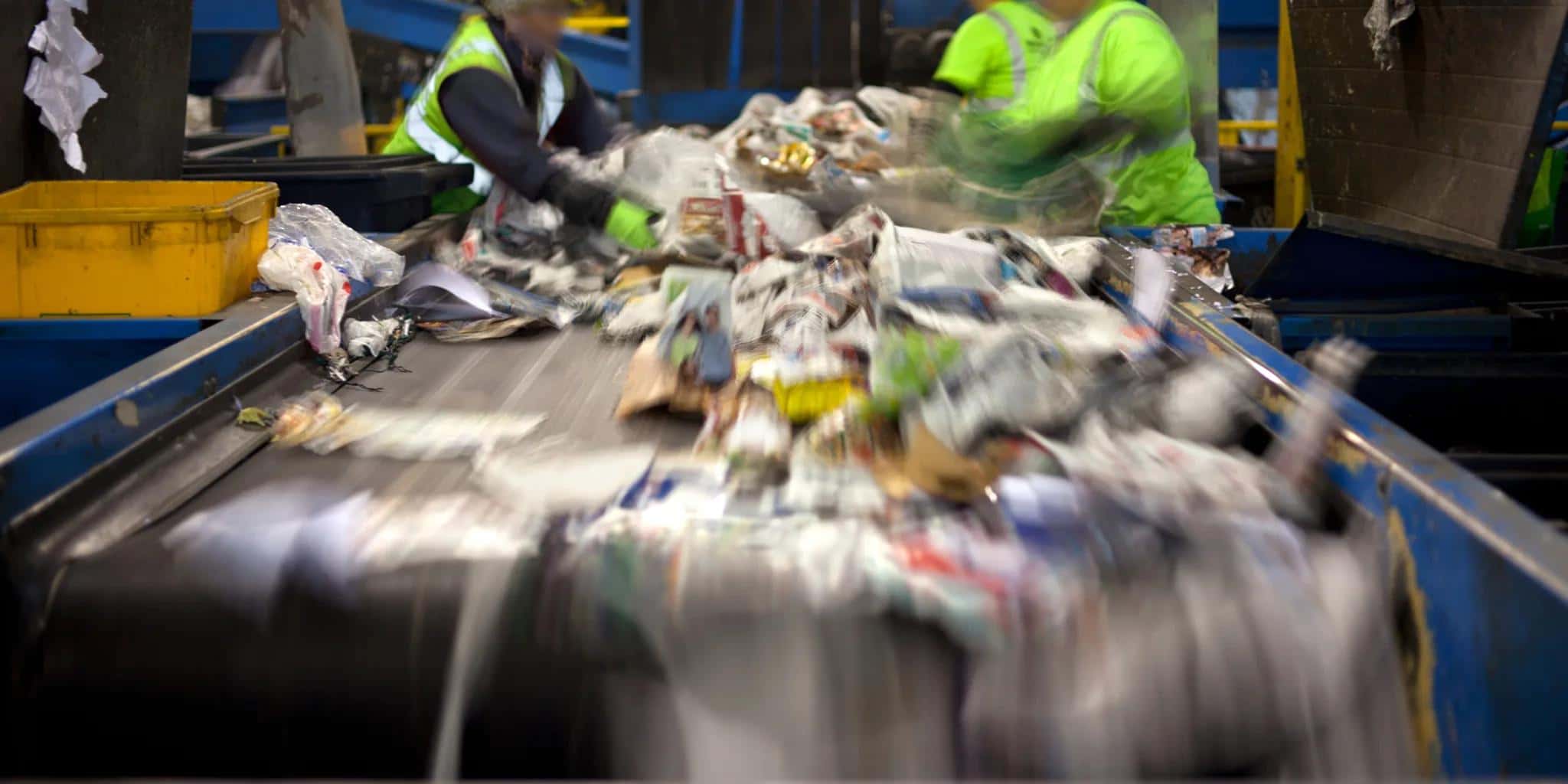
Landfills remain the third largest human-made source of methane globally. Enterprises that implement strategic waste diversion programs reduce their environmental footprint while strengthening their ESG reporting. Get a free consultation with CheckSammy to evaluate your facility's current diversion performance.
What is waste diversion? Waste diversion is the practice of redirecting materials away from landfills and incinerators toward recycling, composting, reuse, or energy recovery. It is a core component of modern sustainability logistics that helps businesses reduce methane emissions, lower disposal costs, and meet regulatory compliance targets. For enterprise operators, effective diversion requires end-to-end chain-of-custody tracking and verified weight data to produce audit-ready ESG reports.
Understanding your organization's material streams is the first step toward building a defensible diversion strategy. This guide covers the definition of waste diversion, the primary diversion strategies available to commercial operators, how to calculate and benchmark your diversion rate. The business case linking ESG compliance to cost reduction, and how CheckSammy's technology-enabled platform delivers verified results at national scale.
What Is Waste Diversion?
Waste diversion refers to the systematic process of redirecting materials from landfill disposal toward beneficial uses such as recycling, composting, reuse, and waste-to-energy conversion. Unlike traditional waste management, which prioritizes collection and disposal, diversion focuses on keeping materials in productive circulation within a circular economy framework. The EPA defines waste diversion as any practice that reduces the volume of solid waste requiring disposal through source reduction, recycling, or composting.
For enterprise-scale operators, waste diversion is not a single action but a coordinated system of material stream management, vendor logistics, data collection, and continuous optimization. Each material type requires a distinct handling pathway to maximize recovery value and minimize contamination.
The Four Core Diversion Pathways
Commercial diversion programs typically operate across four primary channels. Source reduction prevents waste generation at the point of origin through procurement policies, digital transformation, and packaging optimization. Recycling converts collected materials into new products through mechanical or chemical processes. Composting biologically decomposes organic waste into beneficial soil amendments. Waste-to-energy conversion recovers energy from non-recyclable materials through controlled combustion or anaerobic digestion. Each pathway has specific feedstock requirements, processing costs, and end-market dynamics that facility managers must understand when designing their diversion strategy.
Managing Multiple Material Streams at Scale
National enterprises manage dozens of distinct material streams across hundreds of locations, each with unique handling and reporting requirements. A comprehensive chain-of-custody tracking system provides visibility into every material movement from generation through final disposition. Without this infrastructure, organizations cannot verify their diversion claims, identify optimization opportunities, or produce reliable ESG disclosures. Leading operators use technology platforms that integrate real-time weight data, route optimization, and automated reporting to maintain control across their entire portfolio.
Why Is Waste Diversion Important for Businesses?
The business case for commercial waste diversion extends beyond environmental responsibility. Organizations that implement robust diversion programs realize measurable operational benefits including cost reduction, regulatory risk mitigation, brand differentiation, and improved stakeholder confidence.
Environmental Impact and Methane Reduction
Landfills are among the largest human-made sources of methane, a greenhouse gas with a global warming potential approximately 28 times greater than carbon dioxide over a 100-year period. The United Nations Environment Programme identifies methane reduction as the most effective near-term strategy for slowing climate change. Organic materials decomposing in anaerobic landfill environments generate methane continuously for decades. Diverting food waste, yard trimmings, paper, and other biodegradable materials to composting or anaerobic digestion facilities eliminates this methane source at its origin.
Cost Reduction and Operational Efficiency
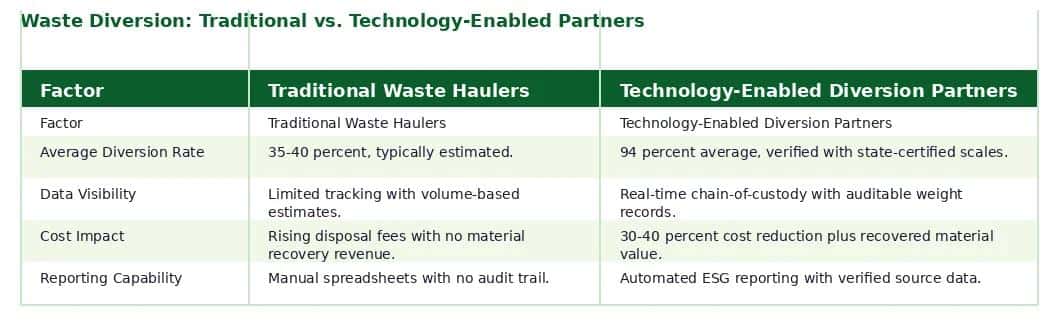
Enterprises that transition from traditional waste haulers to technology-enabled diversion partners report 30-40 percent cost reductions according to CheckSammy's client data. These savings derive from multiple sources: reduced landfill tipping fees, revenue from recovered materials, consolidated vendor management, and optimized collection routes. The EPA confirms that waste diversion programs reduce overall waste management costs by minimizing the volume of material requiring disposal and lowering associated fees.
Regulatory Compliance and ESG Mandates
Federal and state regulations increasingly mandate minimum diversion rates and transparent reporting. Executive Order 14057 requires federal agencies to achieve a 75 percent waste diversion rate by 2030, setting a benchmark that private sector organizations increasingly adopt as a best practice. Multiple states including California, New York, Oregon, and Vermont have enacted commercial organics bans and extended producer responsibility laws that impose diversion obligations on businesses. Organizations that establish robust tracking and reporting infrastructure ahead of regulatory deadlines avoid compliance penalties and position themselves as industry leaders.
Key Waste Diversion Strategies for Commercial Operations
Enterprise operators deploy a layered set of strategies to maximize diversion performance. The most effective programs combine source reduction, material segregation, specialized processing partnerships, and continuous data analysis to improve outcomes over time. Understanding what is waste diversion at the operational level means recognizing how these strategies work together within a unified material management system.
Source Reduction and Reuse Programs
Source reduction eliminates waste before it is generated, making it the highest-impact diversion strategy. Organizations implement reduction through digitization of paper workflows, reusable packaging systems for internal logistics, bulk purchasing to minimize individual packaging, and donation programs for surplus equipment and supplies. According to the EPA's waste diversion guidelines, source reduction also reduces the upstream environmental impact associated with manufacturing, transporting, and disposing of products.
Commercial Recycling Infrastructure
Effective recycling at commercial scale requires upstream segregation at the point of generation, clear labeling and training for facility staff, and reliable downstream processing partnerships. Organizations that implement source-separated collection systems for cardboard, mixed paper, metals, plastics, and glass achieve higher material quality and better recovery rates. Waste audits improve operational efficiency by identifying contamination sources, quantifying recovery opportunities, and establishing baseline metrics for improvement tracking.
Organics Management and Composting
Food waste and organic materials represent a significant portion of the commercial waste stream and are the primary source of landfill methane. Commercial composting programs process these materials through aerobic decomposition to produce nutrient-rich soil amendments. For facilities generating large volumes of organic waste, on-site composting systems or partnerships with regional composting facilities provide the most effective diversion pathway. The EPA recommends commercial organics collection as a priority strategy for meeting high diversion rate targets.
Construction and Demolition Recycling
Construction, renovation, and demolition projects generate substantial material volumes that are highly recyclable when properly managed. Concrete, asphalt, wood, metals, and gypsum board can all be processed into valuable secondary materials. The EPA recommends construction debris recycling as a standard practice for all building projects. Specialized e-waste recycling programs address the unique handling requirements for electronic equipment. Recovering precious metals while ensuring compliant disposal of hazardous components under regulations such as the Resource Conservation and Recovery Act.
Waste-to-Energy as a Final Diversion Pathway
Materials that cannot be recycled or composted due to contamination or composition may still be diverted from landfills through waste-to-energy conversion. Modern waste-to-energy facilities use controlled combustion to generate electricity or heat while reducing waste volume by up to 90 percent. While less environmentally beneficial than recycling or composting. Waste-to-energy represents a better alternative to landfill disposal for non-recyclable materials and serves as a safety net within comprehensive diversion programs.
How Is Waste Diversion Rate Calculated?
To fully understand what is waste diversion in quantitative terms, organizations must master the calculation and benchmarking of their diversion rate. The waste diversion rate is the percentage of total waste that is diverted from landfills and incinerators through recycling, composting, reuse, or other recovery methods.
The Diversion Rate Formula
The industry-standard formula is straightforward. Start with the total weight of diverted material. Divide that by the total weight of all waste generated. Then multiply by 100.
Total Weight of Diverted Material / Total Weight of All Waste Generated x 100 = Diversion Rate.
This gives you your facility's diversion percentage.
For example, if a facility generates 100 tons of total waste and successfully diverts 50 tons through recycling and composting, the resulting diversion rate is 50 percent. All figures must be based on verified scale weights rather than volume estimates to ensure accuracy. The EPA requires documented weight data for official diversion reporting across federal facilities.
Benchmarking and Performance Targets
Most enterprises achieve 0 to 50 percent diversion during the first year of a structured program, with gains driven primarily by basic recycling of paper, cardboard, and metals. Introducing organics collection programs can push rates above 75 percent, the target established by Executive Order 14057 for federal agencies by 2030. Organizations pursuing zero-waste certification typically target 90 percent or higher. Requiring comprehensive management of every material stream including complex categories such as construction debris, electronic waste, and specialized industrial byproducts.
- Conduct a baseline waste audit. Measure every material stream across all operating locations to establish your current diversion rate and identify the largest improvement opportunities.
- Implement source-separated collection. Deploy clearly labeled bins, comprehensive signage, and staff training to ensure materials are properly segregated at the point of generation.
- Partner with a technology-enabled provider. Select a vendor that offers state-certified scale weights, chain-of-custody documentation, and real-time reporting for audit-ready diversion verification.
The Verification Imperative
Unverified diversion claims expose organizations to greenwashing accusations and regulatory risk. Many traditional haulers provide volume-based estimates rather than actual scale weights, creating significant reporting inaccuracies. CheckSammy's platform uses state-certified scales at every processing touchpoint to capture precise weight data, ensuring that improved diversion rates are backed by verifiable evidence suitable for ESG audits, investor reporting, and regulatory compliance documentation.
The Business Case: ESG Compliance and Cost Savings Through Diversion
For Fortune 500 organizations, the question of what is waste diversion increasingly starts as an environmental inquiry but resolves as a financial strategy. Diversion programs deliver measurable ROI through disposal cost reduction, recovered material revenue, regulatory compliance assurance, and enhanced brand equity with sustainability-conscious stakeholders.
Driving ESG Frameworks with Verifiable Data
Modern ESG reporting frameworks require quantifiable, auditable evidence of environmental impact. The Sustainability Accounting Standards Board, Global Reporting Initiative, and Task Force on Climate-Related Financial Disclosures all emphasize the importance of verifiable waste metrics. CheckSammy's technology platform provides the chain-of-custody tracking and diversion verification that organizations need to satisfy these requirements with confidence. Organizations that achieve zero-waste certification, requiring independent verification that 90 to 100 percent of waste is diverted from landfills, differentiate themselves in competitive RFP processes and investor evaluations.
Federal Mandates and Regulatory Trajectory
The regulatory landscape for waste management is evolving rapidly. Beyond Executive Order 14057's 75 percent diversion mandate for federal agencies, state-level policies are expanding commercial diversion requirements. California's SB 1383 requires commercial businesses to divert organic waste. New York's waste reduction and recycling laws impose mandatory commercial recycling programs. European Union directives increasingly influence multinational corporate standards. Organizations that build robust diversion infrastructure now position themselves ahead of this regulatory trajectory rather than responding reactively to compliance deadlines.
Measurable Cost Reduction at Scale
The operational economics of waste diversion create a compelling financial case. Enterprises transitioning to technology-enabled diversion partners report 30-40 percent reductions in total waste management costs. These savings compound annually as diversion rates improve and recovery programs mature. The benefits of waste diversion extend to procurement simplification, vendor consolidation, and reduced administrative overhead from managing a single national partner instead of dozens of local haulers.
Common Waste Diversion Challenges and How to Overcome Them
National enterprises encounter identifiable barriers when scaling their waste diversion programs. Understanding these challenges and their solutions is essential for facility and sustainability executives responsible for multi-location implementation.
Vendor Fragmentation Across Locations
Organizations operating across multiple states often manage contracts with dozens of independent haulers, each with different service standards, reporting formats, and material acceptance criteria. This fragmentation prevents consolidated visibility, complicates benchmarking, and creates administrative overhead. The solution is a unified national partnership with a single provider that delivers consistent service standards, centralized data reporting, and coordinated logistics across all locations.
Data Accuracy and Chain-of-Custody Gaps
Traditional haulers typically provide weight estimates rather than certified scale readings, introducing systematic errors into diversion reporting. Without reliable data, organizations cannot verify their environmental claims, optimize program performance, or defend their metrics during ESG audits. The solution is working with a partner that provides state-certified scale weights at every processing node and maintains a complete digital chain of custody from pickup through final disposition.
Material Contamination and Program Costs
Contamination occurs when non-recyclable materials enter recycling streams, reducing material quality and increasing processing costs. Organizations concerned about upfront program costs may hesitate to invest in the infrastructure needed for comprehensive diversion. Successful waste diversion at scale requires advanced sorting technology such as CheckSammy's ZeroPoint Facilities, which use automated systems to separate complex material streams and remove contaminants before they reach downstream processors.
How CheckSammy Delivers Verified Waste Diversion at Scale
CheckSammy provides end-to-end waste diversion solutions for commercial enterprises across North America. As a technology-enabled partner, we integrate physical collection logistics with real-time data analytics to deliver measurable diversion outcomes. Our platform covers the full material lifecycle from scheduling and pickup through sorting, processing, and verified final disposition for commercial recycling and sustainability services.
ZeroPoint Facilities as Diversion Infrastructure
CheckSammy's proprietary ZeroPoint Facilities function as regional material processing hubs that sort, aggregate, and route complex material streams to their highest-value end markets. These facilities enable CheckSammy to achieve a 94 percent average diversion rate for clients by ensuring that every material type reaches the most appropriate processing pathway. The ZeroPoint model eliminates the contamination and logistics inefficiencies that limit diversion performance in traditional hauler networks.
Verified Chain-of-Custody and Real-Time Data
Every CheckSammy load is tracked through a digital chain-of-custody system that records weight, material composition, processing pathway, and ultimate disposition. State-certified scales at every handoff point ensure that diversion data meets the audit standards required for ESG reporting, regulatory compliance, and third-party certification. Clients access real-time dashboards showing diversion performance across their entire portfolio with drill-down capability to individual facility and material-stream levels.
AI-Optimized Logistics and Automated Reporting
CheckSammy's proprietary AI platform, Sammy, optimizes collection routes and schedules across the national service network to minimize fuel consumption. Reduce service intervals, and improve first-visit completion rates above 99 percent. The platform generates automated sustainability reports that compile diversion metrics, carbon impact calculations, and compliance documentation for direct integration into corporate ESG filings and sustainability disclosures. This facility services technology eliminates the administrative burden of manual data aggregation across multiple vendors.
Frequently Asked Questions
What is the meaning of waste diversion?
Waste diversion is the practice of redirecting materials away from landfills and incinerators through recycling, composting, reuse, source reduction, and waste-to-energy recovery. The EPA defines waste diversion as any activity that reduces the amount of solid waste requiring disposal. For commercial enterprises, effective diversion requires a coordinated system of material segregation, processing partnerships, and verified data tracking to produce defensible environmental claims.
How do you measure waste diversion rate?
The waste diversion rate is calculated by dividing the weight of all diverted materials by the total weight of all waste generated, then multiplying by 100. A facility that diverts 50 tons of material out of 100 tons total achieves a 50 percent diversion rate. Accurate measurement requires certified scale weights rather than volume estimates. According to industry benchmarks, a 50 percent rate is a realistic first-year target for organizations launching new diversion programs.
Why is waste diversion important for enterprise businesses?
Diversion programs deliver measurable business value through 30-40 percent cost reductions compared to traditional hauling, regulatory compliance assurance, and strengthened ESG reporting. Organizations with verified diversion data satisfy investor requirements, differentiate themselves in competitive RFPs, and build stakeholder trust. The EPA recognizes waste diversion as a core strategy for achieving both environmental and economic objectives in commercial operations.
What are the key strategies for improving commercial waste diversion?
Effective diversion programs combine source reduction to prevent waste generation, source-separated recycling collection for core materials. Organics management for food waste streams, specialized processing for construction debris and electronic waste, and waste-to-energy conversion for non-recyclable materials. Commercial waste removal programs achieve the highest diversion rates when they integrate these strategies within a unified management platform that provides end-to-end material tracking and verified reporting.
What diversion rate should an enterprise target?
A 75 percent diversion rate represents the current federal benchmark established by Executive Order 14057 for 2030 compliance. Organizations pursuing industry leadership typically target 90 percent or higher, consistent with zero-waste certification requirements. CheckSammy clients achieve a 94 percent average diversion rate through the combination of ZeroPoint processing infrastructure, verified chain-of-custody tracking, and AI-optimized logistics coordination.
Schedule Your Commercial Diversion Assessment
Every day your organization delays implementing a structured waste diversion program represents lost cost savings and increased regulatory exposure. Traditional hauling models with estimated weights and fragmented vendor management cannot deliver the verified outcomes that modern ESG compliance demands. CheckSammy's technology-enabled platform provides a single national solution for diversion tracking, verified reporting, and measurable environmental impact.
Ready to reach your commercial diversion goals? Contact CheckSammy today to schedule a consultation with our diversion specialists and learn how your organization can achieve verified 94 percent diversion rates with full chain-of-custody documentation.