How ZeroPoint Facility Waste Diversion Works for Enterprises
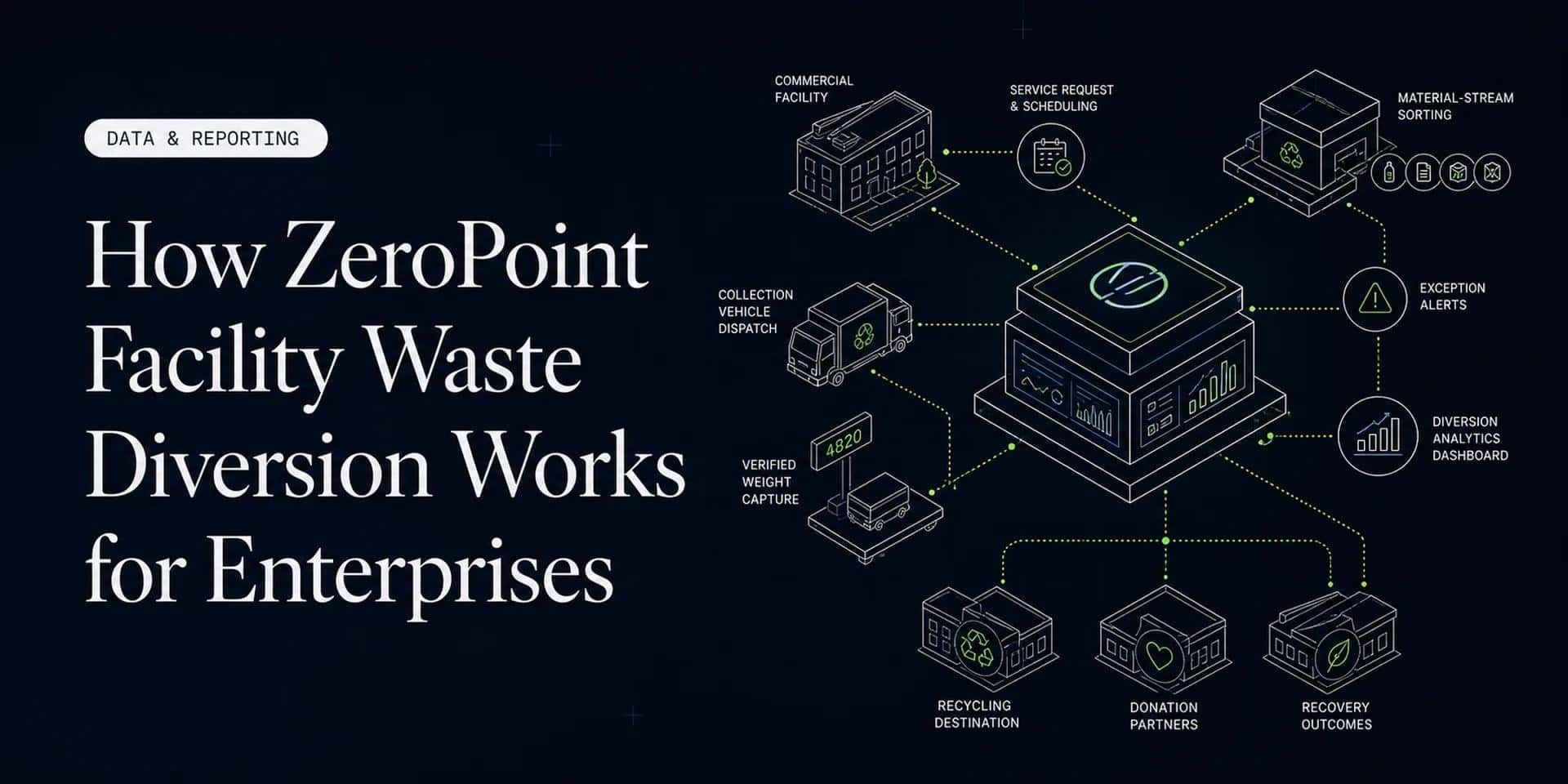
For a multi-location enterprise, waste diversion is rarely limited by good intentions. The harder problem is operational: material moves through dozens or hundreds of sites, vendors. And disposition channels, while sustainability teams still need one reliable view of what happened and where.
ZeroPoint facility waste diversion gives enterprises a controlled way to aggregate, sort, and route complex material streams through proprietary processing hubs, with verified outcomes and visibility from pickup through final disposition.
That model replaces disconnected estimates with a coordinated sustainability logistics system. CheckSammy reports a 94% average diversion rate verified through state-certified scales when applicable, alongside 360-degree chain-of-custody tracking and automated ESG reporting that supports six major frameworks. For teams managing inconsistent materials across a national footprint. The value begins with understanding what these facilities are designed to do and how they extend beyond a traditional hauling model.
What Are ZeroPoint Facilities?
ZeroPoint Facilities are CheckSammy's proprietary sustainability logistics hubs. They are owned processing centers built to give enterprises greater control over what happens to materials after pickup. Rather than treating each service request as an isolated transaction, a ZeroPoint facility helps aggregate materials from multiple client locations. Sort them by stream, and route them toward the most appropriate disposition.
A processing network for complex material streams
Traditional waste models are often designed around predictable, single-stream volumes and routine collection schedules. That approach can leave multi-material or hard-to-divert materials without a clear path. ZeroPoint Facilities are structured to handle more complex operational requirements, including materials that need additional sorting, consolidation, or specialized downstream routing.
For a company managing offices, stores, facilities, or other sites across North America, this distinction matters. Materials from separate locations can enter a coordinated logistics model instead of being managed through disconnected local processes. The result is a more consistent operating framework for sustainability, recycling, recovery, and secure disposition programs.
Control that extends beyond pickup
The facility is only one part of the model. CheckSammy combines its processing hubs with a technology platform that records the movement of materials through the service. Its 360-degree chain-of-custody tracking is designed to provide visibility from pickup through final disposition. That creates an auditable record for teams that need to explain where materials went, how they were handled, and whether the outcome supports internal sustainability objectives.
This level of visibility also distinguishes ZeroPoint facility waste diversion from a model based mainly on estimates. Traditional haulers may report broad collection or diversion figures, while a centralized processing and tracking system can connect activity to specific material flows and service events. For sustainability, procurement, and compliance leaders, that evidence is more useful than a generalized claim that materials were diverted.
Why the model matters at enterprise scale
ZeroPoint Facilities function as the proprietary backbone of CheckSammy's sustainability logistics platform. They connect physical processing with data, making it easier to coordinate complex programs across multiple locations and evaluate results with greater confidence. Explore the ZeroPoint facility waste diversion capabilities to see how the model supports enterprise material management.
How ZeroPoint Facility Waste Diversion Works for Multi-Location Enterprises
ZeroPoint facility waste diversion turns a distributed waste program into a controlled material-flow system. Instead of treating each pickup as an isolated transaction, the process connects activity across dozens or hundreds of locations, from initial collection through final disposition.
1. Materials move into a coordinated network
Enterprise materials are collected through a nationwide network of more than 10,000 vetted professionals and 25,000 facilities. That reach helps organizations coordinate service across different markets while maintaining a consistent operating model. A first-visit completion rate of 99.2% also helps reduce the disruption that missed or incomplete service creates for facility teams.
2. Material streams are sorted by type and condition
After arrival, materials can be separated into distinct streams, such as electronics, textiles, plastics, and metals. Sorting matters because each stream has different handling requirements and different recovery potential. It also creates a clearer record of what entered the system, rather than relying on a broad estimate for a mixed load.
3. Each stream is routed to its highest-value disposition
Once separated, materials are routed according to their condition, composition, and approved handling path. Depending on the material, that may include recycling, recommerce, or certified destruction. This highest-and-best-use approach is consistent with the resource-efficiency principles described in the EPA's TRUE Zero Waste guidance (EPA zero-waste guidance).
CheckSammy reports a 94% average diversion rate, verified through state-certified scales when applicable. For enterprise sustainability teams, that measurement provides a stronger basis for evaluating landfill diversion than an unverified hauler estimate. EPA materials also emphasize tracking material flow as a way to identify opportunities to eliminate waste. In practice, better tracking can help organizations reduce landfill burden and identify avoidable disposal costs across locations.
4. Chain of custody stays visible throughout the process
Chain-of-custody tracking follows materials from pickup to final disposition. That visibility gives facility, procurement, and sustainability leaders a shared record of what happened to each material stream and supports more defensible ESG reporting. The result is not simply a higher diversion percentage. It is an operating process that can be reviewed, compared, and improved across the enterprise.
Learn more about enterprise-grade recycling and waste diversion and how a coordinated program can support multi-location operations.
The Data Advantage: Auditable Reporting for ESG Compliance
For sustainability executives, a diversion claim is only as useful as the evidence behind it. ZeroPoint Facilities connect operational activity to a documented outcome, giving enterprise teams a clearer view of what happened at each location and why.
From intake to final disposition
Each material stream can be scanned, weighed, and tracked as it moves through the network. That creates 360-degree chain-of-custody visibility from pickup through final disposition, rather than relying on a periodic estimate from a downstream provider. Teams can review material composition, disposition pathways, and site-level trends in one reporting environment.
This operating model also supports verification. CheckSammy reports a 94% average diversion rate, verified through state-certified scales when applicable. The underlying records help sustainability and compliance leaders distinguish measured results from assumptions, identify recurring problem streams, and prioritize practical changes across a multi-location portfolio.
Reporting built for enterprise decisions
Real-time dashboards make the data useful before the reporting deadline. Leaders can monitor activity across sites, compare material flows, review carbon impact calculations aligned with EPA methodologies. And use trend analysis to see whether a program is improving over time. Material composition breakdowns can also reveal where reuse, recycling, recovery, or secure disposition options deserve greater attention.
CheckSammy integrates AI-native operations for intelligent dispatch and real-time visibility, helping connect service execution with reporting quality. Automated ESG reporting supports six major reporting frameworks, reducing the manual effort required to assemble recurring updates for internal stakeholders and external disclosures. For programs that include sensitive equipment or data-bearing assets, the platform also supports security requirements associated with SOC 2 Type II and NIST 800-88 practices.
The result is a more defensible operating record for sustainability targets. Instead of treating waste data as a retrospective spreadsheet, enterprise teams can use it to manage vendor performance, investigate exceptions, and communicate progress with greater confidence. Explore data-driven waste diversion reporting to see how the technology layer connects service activity, chain of custody, and ESG visibility.
ZeroPoint Facilities vs. Traditional Waste Diversion Models
For enterprise programs, the meaningful comparison is not simply the hauling rate. It is whether the operating model can verify what happened to each material stream, coordinate multiple locations, and turn recovery data into decisions. ZeroPoint Facilities provide a centralized sustainability logistics model, while traditional haulers and internal programs often depend on regional vendors, site-level processes, or estimates.
Comparison of enterprise waste diversion models
Dimension
ZeroPoint Facilities
Traditional waste haulers
Internal programs
Average diversion rate
94% average diversion, verified through state-certified scales when applicable.
Variable by contract, region, facility, and material stream; reporting may rely on estimates.
Variable and often dependent on local participation, training, and vendor follow-through.
Chain of custody
360-degree documentation from pickup through final disposition.
Limited visibility after collection, depending on the provider and service agreement.
Requires internal controls and coordination across every vendor and site.
Data and reporting
Real-time tracking, material-level visibility, and auditable reporting.
Paper-based or infrequent summaries are common.
Data is frequently consolidated manually from site and vendor records.
Material types
Aggregates, sorts, and routes complex or mixed material streams.
Typically optimized for defined streams and established regional routes.
Capability varies by site expertise, equipment, and local partners.
Coverage
Supports programs across North America through a nationwide network.
Usually regional, requiring multiple contracts for national portfolios.
Built site by site, with uneven standards and operating maturity.
Cost model
Reported cost reductions of 30% to 40% compared with traditional waste haulers, where applicable.
Variable rates, surcharges, and contract structures by market.
Internal labor and coordination costs can be difficult to isolate.
Benchmarks help put the comparison in context. UL 2799 classifies 90% to 94% diversion as Silver, 95% to 99% as Gold, and 100% as Platinum. SCS allows certification from a 50% minimum diversion threshold, while recognizing 99% diversion as Zero Waste for a facility. These standards clarify why a documented 94% average is materially different from an unsupported claim that a program is "green." Sources: UL 2799 and SCS Zero Waste Certification.
The result is a model designed for measurable enterprise performance, not just collection. Organizations evaluating ZeroPoint facility waste diversion capabilities should compare verified outcomes, documentation depth, and the effort required to manage every location.
How to Integrate ZeroPoint Facilities Into Your Waste Strategy
Integrating ZeroPoint Facilities works best as an operational change, not as an isolated service swap. A disciplined rollout gives facility leaders a clear baseline, tests the material-routing model, and creates the data foundation needed to scale across a distributed portfolio.
- Audit material streams across every locationStart with a current-state inventory for each site. Document material types, approximate volumes, pickup frequency, existing vendors, disposition routes, service issues, and reporting gaps. Separate recurring streams from one-time projects, and note where local teams use different terminology or processes. The U.S. Environmental Protection Agency recommends tracking material flow as part of a structured waste-reduction program. A consistent audit makes those flows comparable across locations and exposes the highest-value opportunities.
- Identify materials traditional routes cannot manage wellPrioritize the streams that create the most operational friction or the least visibility. These may include mixed commercial materials, electronics, fixtures, bulky items, or materials that require specialized downstream partners. The goal is not simply to move volume elsewhere. It is to determine which streams need sorting, aggregation, secure handling, or a more transparent chain of custody. This is where ZeroPoint facility waste diversion capabilities can complement existing recycling and service programs.
- Map each stream to the appropriate ZeroPoint facilityShare the audit with the ZeroPoint network and map each material stream to the nearest or most suitable processing location. Consider geography, volume, handling requirements, service windows, and the intended final disposition. For multi-location organizations, this network-based approach can replace disconnected site-by-site decisions with a coordinated routing model. Establish ownership for approvals, manifests, exception handling, and reporting before the first load moves.
- Run a trial load and validate the dataBegin with a representative load from one location or a small cluster of sites. Use the trial to test pickup coordination, intake and sorting, routing decisions, documentation, and reporting quality. Confirm that the resulting records answer the questions sustainability, compliance, procurement, and operations teams will ask. CheckSammy describes 360-degree chain-of-custody tracking from pickup through final disposition, which gives stakeholders a practical standard for evaluating visibility.
- Scale with a consolidated vendor modelOnce the process and data meet requirements, expand to additional locations in measured waves. Multi-location facility managers generally need a consolidated vendor model that reduces fragmented coordination without forcing every site into an identical material profile. Standardize service specifications, escalation paths, reporting fields, and review cadence while preserving local routing requirements. This creates a repeatable operating model for enterprise-grade diversion and makes performance easier to compare over time.